
Indian stock markets are poised for volatility this week, driven primarily by the outcomes of five state assembly elections, ongoing high crude oil prices amid West Asia tensions, and the release of Q4 corporate earnings, according to market analysts.
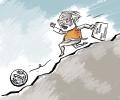
'The large scale and widespread shrinking of the labour force in November, the peaking of unemployment in October and the fall in lead indicators in October and November point towards a worsening of the slowdown of the Indian economy in the third quarter of 2019-20,' says Mahesh Vyas.

Apart from signalling the shape of things to come, the stock markets are seen as an important source of funds for investment - so their health can be critical.

A business in India wanting access to maps and geospatial data would typically have to wait months before it got what it wanted. All this is set to change with the new guidelines on geospatial data, report Neha Alawadhi and Peerzada Abrar.

A V Rajwade wonders if the Modi sarkar is pursuing price stability at the cost of potential social instability in both rural and urban India.

While the lockdown hit employment in all age groups, it hit the employment of youngsters who are less than 29 years of age much more. The lockdown also hit women more than it has affected men, reveals Mahesh Vyas.
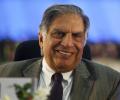
'I think some of us, like Mukesh Ambani, myself and those of us who head industrial units, ought to really focus on what we can really do to make the world a safer place, maybe 50 or 100 years from now.' 'For instance, how can we deal with climate change and global warming, right now?' 'The effects of it may not be felt now; in fact, we may pay a price for it today, but it will help the generations to follow.'

Housing Development Finance Corp (HDFC) chairman Deepak Parekh on Tuesday said that while the country's macroeconomic fundamentals remain strong and the recovery is in progress, the unpredictability of coronavirus will remain a key challenge. Owing to the second wave, the Indian economy is likely to mirror a similar trend seen in FY21, where the first half of the financial year is weaker and the second half is significantly stronger, he said. "I remain confident that India's macroeconomic fundamentals are strong. Recovery is underway," Parekh said while addressing the 44th annual general meeting of HDFC Ltd. He said, the country's forex reserves and foreign direct investment inflows have scaled record highs, the capital markets are also buoyant and agriculture growth is expected to remain strong with food grain production estimated at over 305 million tonnes.

Rural and urban regions present different labour participation and employment levels. These differences also are not tuned to India exploiting its demographic dividend, says Mahesh Vyas.

Gujarat, the home state of Prime Minister Narendra Modi and portrayed as 'growth engine' of India has witnessed a steep fall in new investments for the second quarter of 2014-15 compared to the first quarter of the same fiscal.

The central government's deposits with the RBI had fallen to just Rs 100 crore as of June 8.

Rising unemployment rate reflects a rise in the labour participation rate, which in India's case has been worryingly low.

'Some people even boldly ask for a 100% increase in the salary.'

The employment that is returning is mostly essential services required by Indian households. Most urban Indian households cannot function without a retinue of maids, cooks, drivers, cleaners, notes Mahesh Vyas.

More people felt optimistic about their economic condition in November than in the same month a year ago, says Mahesh Vyas.

Prime Minister Narendra Modi on Saturday inaugurated the 6th India Mobile Congress at Pragati Maidan in Delhi and launched 5G services. The 5G telecom services seek to provide seamless coverage, high data rate, low latency and highly reliable communications system. The three major telecom operators of the country demonstrated one use case each in front of the prime minister to show the potential of 5G technology in India.

'In India, a large proportion of the labour force does not have a regular job.' 'People are mostly employed as daily wage workers, agricultural labourers, small farmers and self-employed traders.' 'These move in and out of "jobs" fairly rapidly.' 'It is the high proportion of these workers in India that makes unemployment volatile,' explains Mahesh Vyas.

The independent institute advising the PM on jobs seems to have missed the point that the challenge is to create net additional jobs, says Mahesh Vyas.

Can 3 crore out of the 8.9 crore young male population of the nine states set off on a pilgrimage that extends for about a month? If yes, then what can we infer regarding the state of the young working population in these states, asks Mahesh Vyas.

If everyone had decent meaningful jobs, the rally maidans would be largely empty and, save for the Akhara babas and curious foreigners and the devout senior citizens, not very many would spare time for the Kumbh Mela, says Mahesh Vyas.

Sticky labour laws and a difficult business environment have led to employers shifting their new hiring in favour of contract labour where social security is much lesser, says Mahesh Vyas.
As of the week ended July 2017, the unemployment rate was 3.1 per cent. This is the lowest unemployment rate recorded. Rural unemployment was also very low at 2.8 per cent.
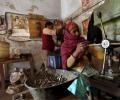
It is necessary that at least three million additional jobs (if not more) are created every year to ensure that there isn't an increase in the stock of unemployed, says Mahesh Vyas.

The retrospective tax decision reversing the January 2012 Supreme Court verdict in the Vodafone case has often been cited as the reason for foreign investors losing confidence in India as an investment destination.

'Let me talk about young Indian startups with their hearts in the right place and how they are proving that innovations that represent 'affordable excellence' -- breaking the myth that 'affordability' and 'excellence' cannot go together -- is indeed possible!' says Dr R A Mashelkar, the eminent scientist, in this fascinating feature.

The industry employs about 10 million workforce.
